HIPAA Fax API
Send and receive HIPAA fax through our advanced API
Connect fax sending, received documents and delivery results to the healthcare software your team builds. HIPAA-compliant faxing with Fax.Plus requires an Enterprise plan, enabled Advanced Security Controls (ASC), and a signed Business Associate Agreement (BAA).
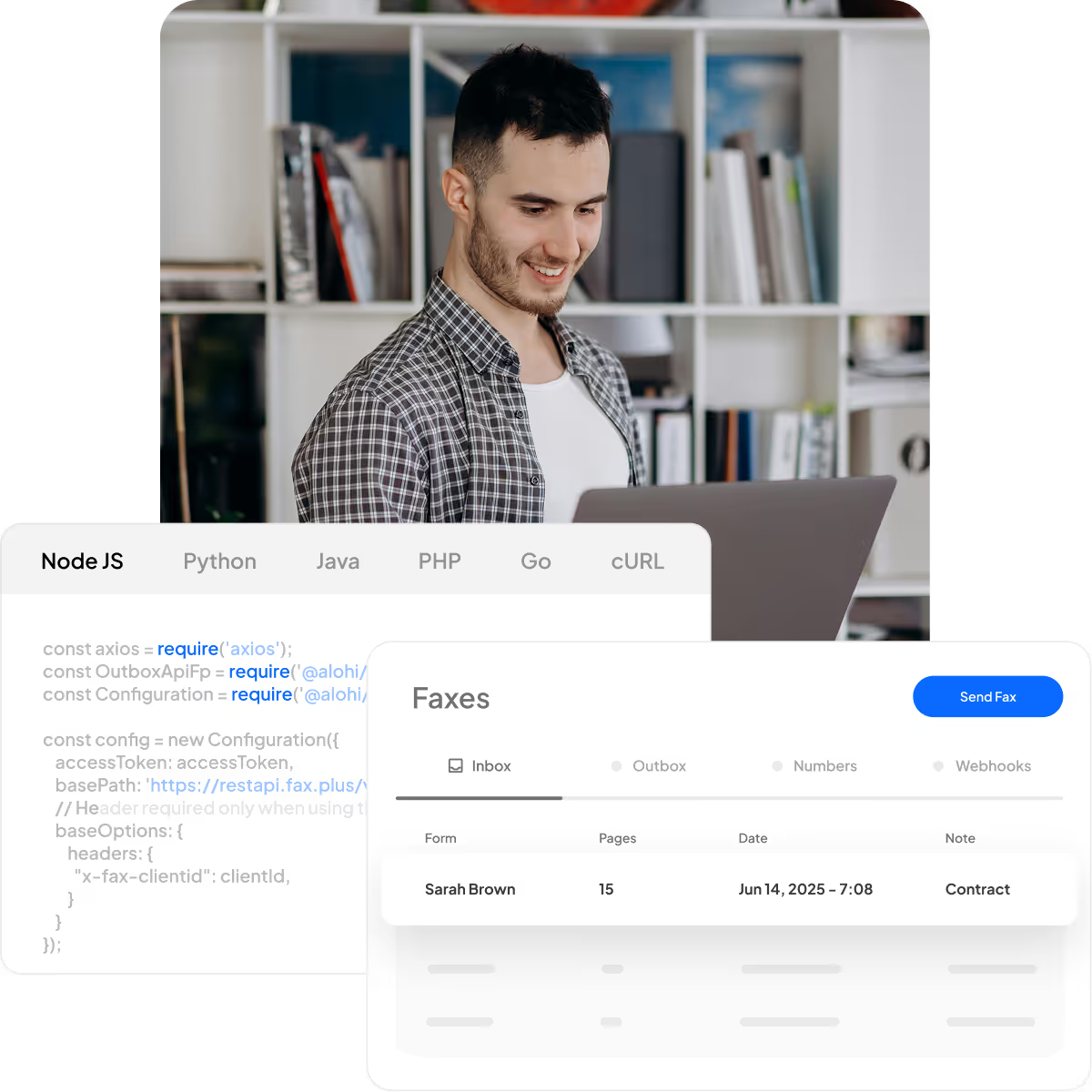






Prepare your healthcare fax workflow
Start with the account, access and one document workflow. Your team builds and maintains the connection to its own software.
Confirm your account
Choose Enterprise, enable Advanced Security Controls and sign a BAA before handling PHI. Agree on a testing arrangement before connecting real documents.
Authorize your application
Choose a Personal Access Token or OAuth 2.0 for your integration. Give credentials and account users only the permissions your workflow requires.
Connect document exchange
Upload the prepared document before submitting a fax. For incoming faxes, use an event notification to start authenticated retrieval into your application.
Check the result
Keep the returned fax IDs and inspect transmission status. Plan how your application handles unsuccessful sends, repeated notifications and unresolved jobs.
Integrate a HIPAA-Compliant Fax API
HIPAA-compliant faxing with Fax.Plus requires an Enterprise plan, enabled Advanced Security Controls (ASC), and a signed Business Associate Agreement (BAA).
Core API Patterns with Fax.Plus
Submit prepared documents, retrieve received faxes and manage pending jobs through the API.
- Keep the identifiers returned for each recipient and track the transmission result.
- Track fax job IDs and check the status before retrying a send. Use
webhook-idto deduplicate webhook events, not outbound fax requests.
Webhooks and Eventing
Use completion events to update your application. Check the transmission status before treating a fax as delivered.
- Verify signed events against the original request body and check the timestamp.
- Save notifications before processing them, then handle retries and replays without repeating the business action.
Data Handling
Fax status webhooks do not include the fax document itself, but they can include sensitive metadata. Retrieve documents through the authenticated API.
- Stored fax files are encrypted using AES-256, with unique keys for each user.
- Limit sensitive metadata in application logs and temporary files. Control the copies your application retrieves.
HIPAA Fax API built for Developers
Build a custom fax connection for your EMR, EHR, client portal or internal application using the REST API and available SDKs. Your developers connect document exchange to the permissions, records and workflow in your system.
Send and receive faxes programmatically through the REST API or supported SDKs.
Track fax status and delivery with real-time status updates, confirmation data, and detailed error codes.
Purchase and manage fax numbers directly through the API as your application or organization scales.
Build event-driven workflows with webhooks and monitor event delivery with logs, replay, signed events, and configurable endpoints.
Control API access securely using OAuth 2.0 or Personal Access Tokens (PATs).
Illustrative examples. Configure credentials, upload documents first and check the current documentation before use.
1const axios = require('axios');
2const OutboxApiFp = require('@alohi/faxplus-api').OutboxApiFp;
3const Configuration = require('@alohi/faxplus-api').Configuration;
4
5const config = new Configuration({
6    accessToken: accessToken,
7    basePath: 'https://restapi.fax.plus/v3',
8    // Header required only when using the OAuth2 token scheme
9    baseOptions: {
10        headers: {
11          "x-fax-clientid": clientId,
12        }
13    }
14});
15
16async function sendFax() {
17    const reqParams = {
18        "userId": '13d8z73c',
19        "payloadOutbox": {
20            "comment": {
21                "tags": [
22                    "tag1",
23                    "tag2"
24                ],
25                "text": "text comment"
26            },
27            "files": [
28                "filetosend.pdf"
29            ],
30            "from": "+12345667",
31            "options": {
32                "enhancement": true,
33                "retry": {
34                    "count": 2,
35                    "delay": 15
36                }
37            },
38            "send_time": "2000-01-01 01:02:03 +0000",
39            "to": [
40                "+12345688",
41                "+12345699"
42            ],
43            "return_ids": true
44        }
45    }
46    const req = await OutboxApiFp(config).sendFax(reqParams);
47    const resp = await req(axios);
48}
49
50sendFax()
from faxplus import ApiClient, OutboxApi, OutboxComment, RetryOptions, OutboxOptions, OutboxCoverPage, PayloadOutbox
from faxplus.configuration import Configuration
outbox_comment = OutboxComment(tags=['tag1', 'tag2'],
text='text comment')
retry_options = RetryOptions(count=2, delay=15)
outbox_options = OutboxOptions(enhancement=True, retry=retry_options)
outbox_cover_page = OutboxCoverPage()
payload_outbox = PayloadOutbox(from_number='+12345667',
to=['+12345688', '+12345699'],
files=['filetosend.pdf'],
comment=outbox_comment,
options=outbox_options,
send_time='2000-01-01 01:02:03 +0000',
return_ids=True,
cover_page=outbox_cover_page)
conf = Configuration()
conf.access_token = access_token
# header_name and header_value required only when using the OAuth2 token scheme
api_client = ApiClient(header_name='x-fax-clientid', header_value=client_id, configuration=conf)
api = OutboxApi(api_client)
resp = api.send_fax(
user_id='13d8z73c',
body=payload_outbox
)<?php
require 'vendor/autoload.php';
$headers = array(
'Accept' => 'application/json',
'Authorization' => 'Bearer {access-token}',
// The x-fax-clientid header is required only when using the OAuth2 token scheme
'x-fax-clientid' => '{client ID}',
);
$client = new GuzzleHttp\Client();
// Define array of request body.
$request_body = ...; // See request body example
try {
$response = $client->request('POST','https://restapi.fax.plus/v3/accounts/{user_id}/outbox', array(
'headers' => $headers,
'json' => $request_body,
)
);
print_r($response->getBody()->getContents());
}
catch (GuzzleHttp\Exception\BadResponseException $e) {
// handle exception or api errors.
print_r($e->getMessage());
}
// ...package main
import (
"bytes"
"net/http"
)
func main() {
headers := map[string][]string{
// The x-fax-clientid header is required only when using the OAuth2 token scheme
"Content-Type": []string{"application/json"},
"Accept": []string{"application/json"},
"Authorization": []string{"Bearer {access-token}"},
"x-fax-clientid": []string{"YOUR CLIENT_ID"},
}
data := bytes.NewBuffer([]byte{jsonReq})
req, err := http.NewRequest("POST", "https://restapi.fax.plus/v3/accounts/{user_id}/outbox", data)
req.Header = headers
client := &http.Client{}
resp, err := client.Do(req)
// ...
}HIPAA Fax APIs Requirements
Combine the signed BAA and account safeguards with appropriate controls in your own application. Decide who can access documents, what is recorded and how long each copy is kept.

Encryption
Stored fax files use AES-256 encryption with unique keys for each user. Apply your organization’s protection requirements to documents retrieved into your application.

Access controls
Limit staff and application access to the work each role requires. Use supported account permissions, SSO and two-factor authentication for authorized team access.

Auditability
Keep fax identifiers and transmission results with the application record. Webhook delivery logs help investigate notification delivery; your application records its own workflow actions.

Data governance
Configure document retention for your account and govern retrieved copies separately. Confirm storage and deletion requirements for every system that handles the documents.
Healthcare use cases
Use a configured healthcare account to connect fax exchange to a workflow your team has built. For example:
Medical records
Submit an approved records packet from your application and retain the fax reference against the request. Check the transmission result before marking the sending task complete.
Referral packets
Receive a referral fax, retrieve the document and pass it to an authorized review queue. Your application controls subsequent filing, routing and any record matching.
Prior authorizations
Send the prepared packet and record its transmission result against the case. Track a payer’s review, request for more information or decision as a separate workflow step.
Plan your HIPAA fax API integration
Discuss account eligibility, document volumes and testing access with our team.
- Review pricing for your expected fax volumes.
- Arrange a Fax.Plus API demonstration.
- Discuss your application’s send and receive workflow.
- Plan a migration from your current fax setup.
- Discuss a suitable API testing arrangement.


FAQ
What makes a fax API HIPAA-compliant?

HIPAA-compliant faxing with Fax.Plus requires an Enterprise plan, enabled Advanced Security Controls (ASC), and a signed Business Associate Agreement (BAA). Your organization must also apply appropriate safeguards to its application, access and document handling.
What is a BAA and why is it required?
A Business Associate Agreement sets out the responsibilities of a covered entity and a service provider when handling PHI. Sign the BAA with Fax.Plus and enable the required account controls before using the service for PHI.
Can I integrate Fax.Plus API with my EHR system?
Your developers can use the Fax.Plus API to build fax exchange into an application workflow. This requires a compatible connection to your system and validation of its document handling. A native EHR integration is not currently available; API access alone does not provide patient matching or automatic chart filing.
Do fax webhooks contain PHI?
Webhooks do not include the fax document itself, but metadata such as fax numbers and filenames can contain sensitive information. Protect that metadata in your receiver and logs, then retrieve documents through the authenticated API.
How can my application confirm that a fax was delivered?
Keep the fax IDs returned for each recipient and check the transmission result. An accepted send request or a completed-session event is not, by itself, proof of successful delivery. A successful transmission does not establish that a person reviewed or accepted the document.
Does Fax.Plus store faxes permanently?
You can configure document retention for your account. Set the policy your organization requires and confirm how it applies to stored faxes. Deleting a fax from Fax.Plus does not delete copies already retrieved into your own systems.
Can I test the API before production?
Contact our team to discuss the testing arrangement available for your integration. Confirm access, destinations and any charges before testing, and use synthetic documents rather than patient information until the required agreements and safeguards are in place.
Continue planning your HIPAA fax integration
Review application connections, account controls and implementation guides for your fax workflow.
Connect systems

Review controls
Operate fax API
Build fax into your healthcare workflow
Plan your account setup, connect your application and track each fax through its transmission result. Give your team a clear path from document preparation to follow-up.


Confédération Suisse
Confederazione Svizzera
Confederaziun Svizra
Swiss Confederation
Innosuisse - Swiss Innovation Agency